Test out a B-cycle for “Ride Your Bike to Work Day”

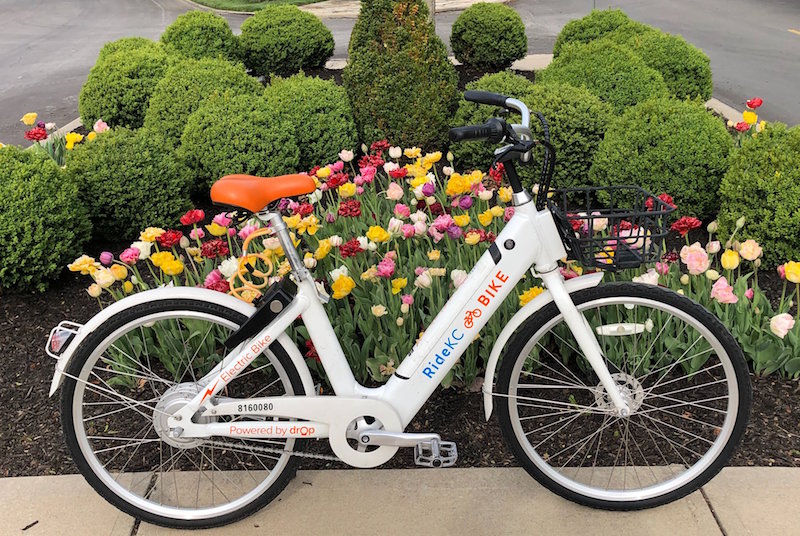
Kansas City B-cycle, Powered by Blue KC, is celebrating “Ride Your Bike to Work Day” by encouraging Kansas Citians in the Downtown area to give its bikes a test run.

People are encouraged to rent one of the 90 B-cycles from any of the 12 docking stations (B-stations) and ride to Ilus Davis Park during the lunch hour. Bike rentals under 30 minutes will be free of charge. Participants are encouraged to bring their lunch and learn about B-cycle, the health benefits of bicycle commuting and how KC is evolving into a more bike-friendly city.

B-cycles will be free to rent for 30 minutes between 11 a.m. – 1 p.m., May 17 to ride to Ilus Davis Park, 11th & Oak near City Hall.

For more information, visit www.kansascity.bcycle.com, email heckold@morningstarcomm.com or call 816-820-6203.

CO2 levels reach all-time high

The National Oceanic and Atmospheric Administration (NOAA) reported May 9 that the daily mean concentration of carbon dioxide in the atmosphere of Mauna Loa, Hawaii, surpassed 400 parts per million (ppm) for the first time since measurements began in 1958. The best available evidence implies that levels have not been this high for at least 3 million years.

This marks an important and long-feared milestone. Because Mauna Loa is the oldest continuous carbon dioxide (CO2) measurement station in the world, it is the primary benchmark site for tracking the increase of this powerful heat-trapping gas across the globe.

Scientific research shows carbon dioxide (CO2) pumped into the atmosphere by human activities—such as burning fossil fuels—is the most significant greenhouse gas (GHG) contributing to climate change. Its concentration has increased every year since scientists first started taking measurements at Mauna Loa more than five decades ago. The rate of increase has increased since then, from about 0.7 ppm per year in the late 1950s to 2.1 ppm per year during the last 10 years.

“That increase is not a surprise to scientists,” said NOAA senior scientist Pieter Tans, with the Global Monitoring Division of NOAA’s Earth System Research Laboratory in Boulder, CO. “The evidence is conclusive that the strong growth of global CO2 emissions from the burning of coal, oil, and natural gas is driving the acceleration.”

“There’s no stopping CO2 from reaching 400 ppm,” said Ralph Keeling, a geochemist at the Scripps Institution of Oceanography. “That’s now a done deal. But what happens from here on still matters to climate, and it’s still under our control. It mainly comes down to how much we continue to rely on fossil fuels for energy.”

For more information, visit www.noaa.gov.

New camera showcases urban peregrine falcon nest

Kansas Citians can now get a live look at the peregrine falcon nest atop the Commerce Tower downtown, and are encouraged to watch their behaviors as the season progresses. The eggs are expected to hatch sometime in mid-May, and the young birds could be ready to fly by mid-June. After that, the nest will be empty for the rest of the year, although the falcons will stick around until they migrate. The nest is part of a peregrine falcon restoration program that began when young birds were released in 1991 at Commerce Tower.

The peregrine falcon nesting box located atop the Commerce Tower is a partnership between Missouri Department of Conservation (MDC) and NAI Capital Realty. The Commerce Tower remains the exact location in which MDC originally began releasing peregrine falcons in 1991. A total of 24 falcon chicks were released during the summers of 1991 and 1992. Since then, the Commerce Tower has remained a preferred nesting location of the peregrine falcons.

To view the live Web feed, visit www.mdc.mo.gov/discover-nature/wildlife-cameras/kansas-city-falcon-web-camera.

Greater Kansas City Regional Trails & Bikeways map is now available

Just in time for National Bike Month in May, a new KC Regional Trails and Bikeways map is available for area bicyclists and walkers. The Mid-America Regional Council worked with local governments to produce the map using aerial photography, global positioning and geographic information systems (GIS) data to provide the most up-to-date information available.

The previous version of the map had a total of 702 miles of trails and bikeways. The new map shows 1,273 miles of trails and bikeways, including:

  • 45 miles of bike lanes.
  • 83 miles of mountain bike trails.
  • 175 miles of walking and hiking trails.
  • 188 miles of bike routes.
  • 225 miles of “share the road” bikeways.
  • 555 miles of paved trails.

The map is printed on an eco-friendly, tree-free paper that is durable and recyclable. The printed map is FREE and available from local community centers.

For the more tech-savvy biking and hiking crowd, MARC has also developed a free Regional KC Bike Map web app that can be used to view the map on a smartphone, tablet or computer browser. The web app has all the same details as the print version. The web app will also be updated as new information becomes available. The app — which should be used safely, not while riding or driving — is available at marc.org/bikemap .

MARC will host a launch party for the Bike Map and the Regional KC Bike Map web app on Friday, May 10, from 4–5:30 p.m., at Garment District Place Park on 8 th Street between Broadway and Washington, in Kansas City, Mo. A limited supply of free maps will be available at the event, and staff will be on hand to help install and demonstrate the web app.

A list of additional Bike Month events is available online at marc.org/exploreKC .

Recycling on the upswing across the metro

A recent survey shows that 67 percent of area residents are recycling more compared to five years ago, in large part because it has become easier as curbside recycling is now widely available. Familiarity and satisfaction with recycling services are increasing as well.  With this increased awareness, the region is also seeing increased support for expanding and improving waste reduction and recycling services.

Between October 2012 and January 2013, the Mid-America Regional Council (MARC) Solid Waste Management District conducted a recycling survey of residents in the nine-county Kansas City metro area. The survey results will help the district evaluate current recycling activities and awareness, determine what recycling services residents would like to see in the future, and determine focus areas for expanded services and outreach priorities. The district also compared results with 2005 and 2008 survey data to determine how citizens’ values, behavior and awareness levels have changed.

Some of the most telling survey results:

  • Residents’ satisfaction with three key recycling services increased from 2008 to 2012: Satisfaction with curbside recycling service was up 20 percent; satisfaction with yard waste collection and composting services was up 9 percent; and satisfaction with the location of drop-off recycling centers was up 7 percent.
  • More than two-thirds of residents feel their community is performing well in terms of its commitment to recycling.
  • There is a significant increase in the number of residents who reported they were recycling everything possible — from 39 percent in 2008 to 57 percent in 2012.
  • 58 percent of area residents are willing to recycle their food waste curbside.
  • The top services that area residents would like to see offered or expanded in their community are materials accepted curbside, household hazardous waste collection services, glass container recycling services, and computers/electronics recycling services.
  • There is a significant increase in support for area local governments to implement mandatory recycling for residents, businesses and institutions.
  • More than 90 percent of area residents feel local government should play a leadership or supportive role in educating residents about and developing policies on waste reduction and recycling.
  • 60 percent of area residents are willing to pay for their trash services based on the amount of trash they set out for disposal. This “pay-as-you-throw” concept typically increases recycling and reduces the amount of waste sent to landfills.

To read the complete survey visit: www.marc.org/Environment/SolidWaste/2012survey.htm .

For more information on where to recycle old paint, televisions, computers, glass, household items and much more, visit www.RecycleSpot.org .